

Before You Travel to China:The Ultimate China Travel App Guide (2026)What Works, What Doesn't & What Every Visitor Should Know
Updated for 2026 | Practical travel advice from a Shanghai cultural studio welcoming guests from over 40 countries.
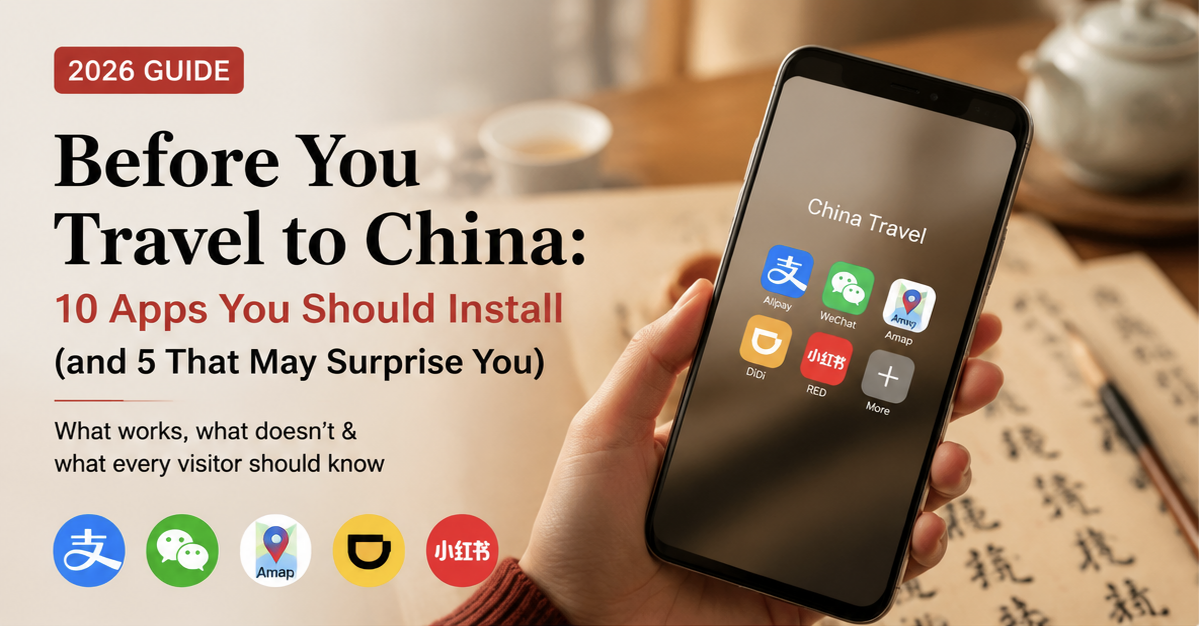
10 Apps you should install before you travel to China
Planning Your Trip to China?
Last week, one of our guests from the United States joined our Chinese dumpling workshop in Shanghai with his daughter.
During class, he mentioned that together they had taken cooking classes in six different countries. They were experienced travelers who loved discovering local culture through food.
Yet before arriving in Shanghai, they had planned much of their trip using Google Maps.
That conversation reminded us of something we hear surprisingly often.
Many international visitors prepare carefully before coming to China—but some of the information they rely on is surprisingly outdated.
China's digital ecosystem is very different from what most travelers are used to.
Some apps work perfectly.
Some require a VPN.
Others technically work but no longer provide reliable or up-to-date information.
If this is your first visit to China, this guide will save you a lot of confusion.
1. Apps You Should Install Before Your Flight
Alipay ⭐⭐⭐⭐⭐
If you install only one app before arriving in China, make it Alipay.
Today, Alipay is much more than a payment app.
You'll use it for:
Restaurants
Coffee shops
Convenience stores
Street food
Metro tickets
Bike sharing
Taxi payments
Some attraction tickets
International credit cards are now widely supported.
However, we still recommend carrying a small amount of cash for emergencies or smaller vendors.
👉 Related Reading
Why We Still Recommend Carrying Cash in China (Even If You Have Alipay)
Many visitors think WeChat is simply China's version of WhatsApp.
It's much more than that.
Hotels, restaurants, activity hosts and local contacts often communicate through WeChat.
Even if you don't use it every day, having it installed makes your trip much smoother.
Didi
Think of Didi as China's Uber.
The good news?
You don't even need the standalone app.
You can book rides directly inside Alipay.
2. These Apps Still Work... But There's a Catch
These apps generally require a VPN in mainland China.
Google Search
Gmail
Google Drive
Google Photos
Google Translate
WhatsApp
Instagram
Facebook
YouTube
X (Twitter)
If you rely on any of them, install and test your VPN before you leave home.
3. The Apps That Surprise Travelers the Most
Google Maps & Google Reviews
This is probably the biggest surprise for first-time visitors.
Many travelers assume Google Maps works the same way it does in Europe or North America.
Unfortunately, that's often not the case.
Without a VPN, Google Maps usually won't load at all.
Even with a VPN, the information can be incomplete or outdated.
Many businesses that have opened in recent years simply don't appear.
Even restaurants, cafés, cultural studios, and attractions that have been operating successfully for 10 years or more may still be missing from Google's database.
That also explains why Google Reviews can be misleading in China.
Sometimes a place doesn't have "only a few reviews."
It simply doesn't exist on Google Maps at all.
We've experienced this ourselves.
Occasionally, guests tell us they couldn't find Yin Studio on Google Maps before their visit.
Our studio has welcomed travelers from around the world for years, but like many independent businesses in China, it simply isn't fully represented on Google Maps.
The same thing happens with countless cafés, restaurants, workshops, and local businesses throughout Shanghai.
So if you can't find a place on Google Maps, don't assume it's closed.
It may never have been added.
Instead, locals usually use:
Amap (Gaode Maps)
Apple Maps
Baidu Maps
These platforms provide much more accurate information, navigation, business listings, and public transportation.
Travel Tip
If you hear locals recommending an amazing restaurant but can't find it on Google Maps, don't give up.
Try searching on Apple Maps or Amap instead—you may discover one of your favorite places in China.
Uber
Uber no longer operates independently in mainland China.
Use Didi, which supports English and works well with international payment methods.
Yelp
Yelp has very limited coverage in China.
Most restaurants and cafés won't have meaningful listings or reviews.
Tripadvisor
Tripadvisor is still useful for planning your trip before arrival.
However, many neighborhood cafés, local restaurants, cultural workshops, and newly opened attractions simply aren't listed there.
4. Optional Apps That Can Make Your Trip Easier
These aren't essential, but they're worth considering.
Apple Maps
If you're using an iPhone, Apple Maps performs surprisingly well in China.
For many visitors, it's much more reliable than Google Maps.
Amap (Gaode Maps)
China's most widely used navigation app.
Excellent for walking, driving, metro routes, and discovering local businesses.
Microsoft Translator / Apple Translate
Useful for menus, signs, and basic conversations.
Download offline language packs before your trip whenever possible.
Red Note(Xiaohongshu)
Want to discover the cafés, exhibitions, parks, seasonal events, and restaurants that locals actually visit?
RED has become one of China's most popular lifestyle platforms.
Even if you don't create an account, it's a great source of travel inspiration.
Our Personal Advice
Every week, we meet travelers from around the world.
Some arrive with twenty travel apps.
Others have only Alipay and a notebook.
The guests who usually enjoy China the most aren't necessarily the ones with the most technology.
They're the ones who stay curious.
Who ask questions.
Who aren't afraid to step away from Google and discover places through local recommendations.
Sometimes the best meal isn't the restaurant with thousands of online reviews.
Sometimes it's the tiny neighborhood shop your host points out on the way home.
And sometimes, the most unforgettable memory isn't something you planned at all.
Planning a Cultural Experience in Shanghai?
If you're interested in experiencing Chinese culture beyond sightseeing, you may also enjoy these guides from our blog: